Quick Answer: South Orange County’s retail growth is revealing a critical infrastructure issue – aging sewer systems in properties built 30-50 years ago weren’t designed for today’s usage demands. Commercial properties in Mission Viejo, Laguna Hills, Lake Forest, and Aliso Viejo are discovering pipe failures during peak business seasons. Lomonaco Coast Plumbing provides camera inspection, trenchless CIPP repair, and preventive maintenance for commercial properties. Call (949) 933-3871.
Location: 929 Calle Negocio, Ste F, San Clemente, CA 92673 | Phone: (949) 933-3871 | Commercial Service: 24/7
The Problem Nobody Saw Coming
South Orange County is booming right now. New restaurants opening. Retail centers staying full. Shopping districts thriving. Post-pandemic retail bounce-back is real and business is good.
But there’s a problem underneath all this success that property owners and managers are discovering the hard way.
The pipes under these properties are old. Really old. And they’re failing.
We’re talking about commercial buildings built in the 1970s, 1980s, and 1990s when South Orange County was first developing. Master-planned communities that looked toward the future – except nobody thought about what those sewer systems would look like 40-50 years later under completely different usage demands.
Those pipes are hitting their lifespan limits right now, right when business is best and nobody can afford downtime.
Why This Is Happening Now
The Buildings Are Hitting Critical Age
Most commercial sewer pipes have a realistic lifespan of 40-60 years depending on material and conditions.
Cast iron pipes installed in 1980? They’re 46 years old now. Clay pipes from 1975? 51 years old. Original pipes from when these master-planned communities first developed are all hitting that failure zone at the same time.
And unlike residential properties where one house has issues, commercial centers have dozens of businesses all connected to the same aging infrastructure. When it fails, it fails big.
Usage Patterns Changed Completely
Buildings designed in 1985 weren’t built for how we use them today.
Restaurants back then didn’t have the grease output modern kitchens produce. Retail spaces didn’t have the bathroom traffic current customer volumes create. Food courts and dining areas are way busier than original designs anticipated.
The pipes were sized and designed for 1980s usage. They’re handling 2026 demands. Something’s gotta give.
Nobody Did Preventive Maintenance
Be honest – when’s the last time anyone looked at the sewer system under your property? Not when something broke. Just a regular check-in to see how things are doing.
Probably never.
These systems went 30-40 years with zero proactive maintenance. Just reactive emergency repairs when things failed. All that deferred maintenance is catching up now.
Where We’re Seeing This
The Shops Area and Surrounding Retail
Major shopping centers that have been landmarks since the 1980s are dealing with sewer system issues throughout their properties.
Multiple tenant spaces sharing aged sewer infrastructure. One restaurant’s grease problem becomes everyone’s problem. Root intrusion affecting entire sections. Corroded pipes that are basically held together by hope.
Property managers discovering that what they thought was one tenant’s isolated issue is actually a systematic infrastructure failure affecting the whole center.
Alicia Parkway Corridor
The commercial strip along Alicia has been there since the area first developed. Restaurants, retail, medical offices – all on aging sewer systems showing their age.
We’re getting calls from property managers who’ve had three different tenants complain about slow drains in the past year. That’s not a coincidence. That’s infrastructure deterioration.
Crown Valley Business District
Professional offices, medical buildings, mixed-use retail – lots of properties from the original development boom are discovering pipe problems.
The thing about medical and professional offices – they absolutely cannot have sewer backups disrupting operations. But that’s exactly what’s happening when 40-year-old pipes fail.
Laguna Hills Mall Area
Shopping centers and commercial properties surrounding the mall – many dating from the same era as the original mall construction – are all aging at the same rate.
Restaurants in these centers particularly affected because they stress sewer systems more than typical retail, and the pipes weren’t designed for modern restaurant volumes.
Lake Forest Business Parks
Office parks and business centers from the original Lake Forest development are facing the same issues. Professional buildings where sewer backups create serious tenant relations problems and potential lease issues.
Aliso Viejo Town Center Vicinity
Even some of the “newer” areas from 1990s development are showing problems. 30-year-old infrastructure hitting the age where issues start appearing.
What Actually Fails First
Root Intrusion
All those beautiful mature trees in South Orange County’s master-planned communities? Their roots have been slowly working into sewer lines for 30-40 years.
Roots seek moisture. They find the tiniest cracks in aging pipes. They grow into thick masses that catch debris and create complete blockages.
For commercial properties, this means recurring backups that keep getting worse. Cable snaking provides temporary relief, but roots grow back within months because the entry points remain.
Grease Buildup in Restaurant Lines
Modern restaurant kitchens produce way more grease than 1980s systems anticipated. High-volume fryers, multiple cooking stations, continuous operation.
That grease goes down drains, cools in pipes, solidifies, builds up layer by layer. Eventually it creates blockages that shut down kitchens during peak service.
Corroded Cast Iron Pipes
Cast iron was the standard for commercial construction in the 1970s-1980s. It was considered permanent, maintenance-free infrastructure.
Turns out cast iron corrodes. From the inside out. After 40-50 years, those pipes are deteriorating, developing holes, losing structural integrity.
The failure isn’t gradual. It’s sudden. Pipe that seemed fine one day collapses the next.
Offset Joints from Ground Settlement
South Orange County has had earthquakes, ground movement, natural settling over 40 years. All that movement affects underground pipes.
Joints separate. Pipes shift out of alignment. Creates spots where flow restricts and debris collects.
For commercial properties, this means certain sections consistently clog while camera inspection shows the pipes themselves look okay – it’s the alignment that’s wrong.
The Business Impact
Let’s talk about what this actually costs businesses when pipes fail.
Lost Revenue
Restaurant closed for emergency repairs during weekend? That’s $15,000-$40,000 in lost revenue for a typical operation.
Retail store with bathrooms out of order sending customers away? Hard to quantify but definitely real.
Medical office canceling appointments because plumbing failed? Patients rescheduled, revenue delayed, reputation damaged.
Emergency Repair Costs
Emergency plumbing costs 2-3x regular pricing. After-hours service, weekend response, urgent situations all command premium rates.
Average emergency commercial sewer repair: $5,000-$15,000
Same repair scheduled proactively during slow period: $2,000-$6,000
Tenant Relations
For property managers and retail center owners, tenant relations matter. One tenant’s repeated plumbing issues affect lease renewals, tenant satisfaction, property reputation.
When the problem is actually shared infrastructure, multiple tenants affected simultaneously creates management nightmares.
Health Department Issues
Restaurants and food service operations can’t mess around with sewer backups. Health department gets involved. Potential closures. Compliance documentation required.
One sewage backup incident can trigger inspections, fines, required corrective action that goes way beyond just fixing the immediate problem.
Why Traditional Repairs Don’t Work Well Here
Traditional excavation-based sewer repair in commercial retail settings creates major problems:
Customer access disruption – Tearing up parking lots or common areas means customers can’t reach businesses. Lost foot traffic kills retail and restaurant revenue.
Extended timelines – Traditional excavation takes 2-4 weeks. Commercial properties can’t afford that kind of disruption during good business periods.
Multiple tenant impact – Work affecting shared infrastructure disrupts all connected businesses simultaneously.
Property aesthetics – Retail centers depend on curb appeal. Construction equipment and torn-up properties drive customers away.
Coordination complexity – Getting access, coordinating with multiple tenants, managing disruption across a commercial center is a logistical nightmare.
What Actually Works: Trenchless CIPP
CIPP (Cured-In-Place Pipe) technology solves the specific problems commercial retail properties face.
Creates new pipe inside old pipe – zero excavation. Installs in 1-2 days. Businesses stay open. Customers never know work is happening.
For retail centers:
- No parking lot closures
- No customer access disruption
- No visible construction affecting curb appeal
- Minimal coordination needs
- Fast completion minimizing impact
For property managers:
- One permanent fix vs. recurring emergency repairs
- Scheduled during slow periods avoiding peak business times
- All tenants served by repaired infrastructure benefit
- 50+ year lifespan solving problem long-term
Pricing reality:
- Traditional excavation + restoration: $40,000-$100,000
- CIPP trenchless: $25,000-$60,000
- Savings: $15,000-$40,000 plus zero business disruption
Camera Inspection: Where Smart Property Managers Start
You can’t fix what you don’t understand. Camera inspection shows exactly what’s happening underground.
For commercial properties in South Orange County, camera inspection reveals:
System-wide assessment – Not just one problem spot, but the entire shared infrastructure condition
Deterioration extent – How much of the system is affected, what’s urgent vs. what can be monitored
Root intrusion patterns – Where roots are entering and how extensive the problem is
Grease buildup severity – For centers with restaurant tenants, shows grease management effectiveness
Structural issues – Offset joints, collapsed sections, corrosion levels throughout system
Cost: $299-$699 for commercial camera inspection depending on system complexity
Value: Prevents $50,000-$150,000 emergency situations and enables proactive planning
Preventive Maintenance for Commercial Properties
Properties discovering infrastructure issues now are switching to preventive maintenance programs.
What this includes:
Annual camera inspection – Monitoring system condition, catching developing problems early
Regular hydro jetting – Especially for restaurant-heavy centers, removing grease before it creates blockages
Scheduled CIPP – Phased rehabilitation of aging sections before complete failures
Emergency priority – When issues do occur, maintenance plan customers get priority response
Cost: $400-$1,200 monthly depending on property size and tenant mix
ROI: Avoid $75,000-$200,000 in emergency repairs and business disruption over 3-5 years
Real South OC Scenarios
Laguna Hills Shopping Center
Three restaurant tenants. Repeated grease line backups. Property manager spending $3,000-$5,000 every few months on emergency cleanings.
Camera inspection revealed 50-year-old cast iron pipes deteriorated throughout, plus massive root intrusion from parking lot trees.
CIPP solution: $45,000 rehabilitation of main sewer serving all three restaurants. Zero excavation under parking lot. Installed over two nights when restaurants were closed.
Result: 18 months later, zero emergency calls. Restaurants operating smoothly. Property manager wishes they’d done it years ago.
Crown Valley Professional Building
Medical and dental offices. Sewer backup affecting three suites simultaneously. Tenants threatening lease action.
Emergency repairs provided temporary fix. Two months later, same problem.
Camera showed original 1982 clay pipes with multiple offset joints from ground settlement plus root intrusion at six locations.
CIPP solution eliminated all entry points. Spot repairs addressed offsets. Comprehensive fix vs. band-aid emergency patches.
Alicia Parkway Retail Strip
Five connected businesses sharing aged infrastructure. One tenant’s repeated issues affecting neighboring businesses.
Property manager finally did comprehensive camera inspection. Discovered 40% of shared system was severely deteriorated.
Phased CIPP rehabilitation over three months during slow business periods. Each phase took 1-2 days. Businesses stayed open throughout.
Total investment $38,000 – less than previous three years of emergency repairs combined.
May Timing Matters
If you manage commercial property in South Orange County, May is actually perfect timing for addressing infrastructure issues.
Before summer peak – Retail and restaurant peak season hits June-August. You want issues handled before your busiest revenue months.
Weather cooperation – Spring weather ideal for any exterior work if small access points needed.
Fiscal year planning – Many commercial properties work on fiscal years starting July 1. Get projects approved and completed before new budget year.
Preventive window – Problems developing now will become emergencies during peak season. May gives you time to be proactive.
What Property Managers Should Do
Schedule camera inspection – See exactly what’s happening in your infrastructure before you’re dealing with emergencies.
Get comprehensive assessment – Not just one problem spot, but overall system condition and remaining lifespan.
Plan strategically – Understand what needs immediate attention vs. what can be phased over time matching budget cycles.
Consider CIPP – For aging infrastructure, trenchless rehabilitation often makes more sense than ongoing emergency repairs.
Establish maintenance program – Regular hydro jetting and monitoring prevents emergency situations.
Contact Us for Commercial Service
Call (949) 933-3871 – Talk to commercial services coordinator about your property
Email: [email protected] – Send property details for preliminary assessment
Schedule camera inspection – See what’s actually happening underground
schedule an appointment
our services




issues we address
With NuFlow trenchless pipelining solutions, we address the most common problems in residential and commercial sewer lines. This pipe lining process fixes:
advantage of nuflow technology
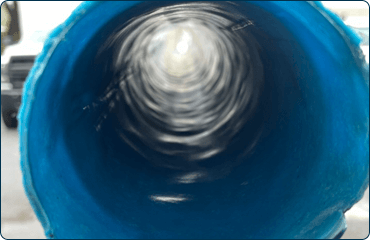
NuFlow trenchless pipe restoration allows us to repair your pipe with minimal disruption to your daily activities. As we don't have to dig a trench, you won't have to deal with repairing your landscaping, driveway, or sidewalk. NuFlow restoration works on clay, cast iron, concrete, plastic, copper, and steel pipes. The new pulled-in pipe features a lifespan of at least 50 years.

main reasons to work with us
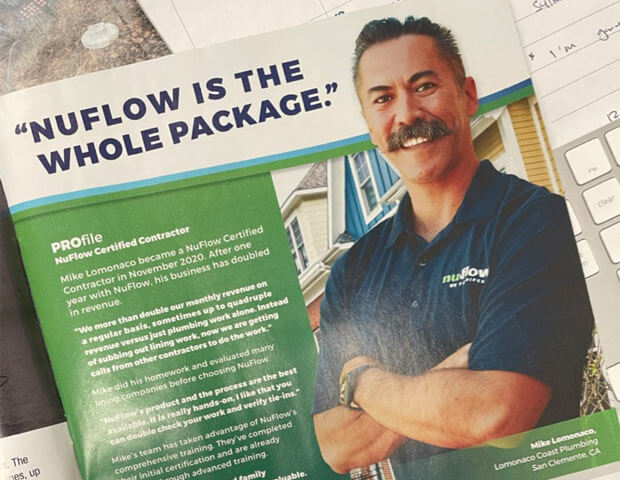
Our team gets the job done right the first time. We update you throughout the project, and we check in afterward to ensure your satisfaction with our work. As a family-owned and operated business, we offer:
schedule a pipe lining service today
Lomonaco Coast Plumbing & Pipelining proudly serves all home and business owners in the local area. Our on-time arrival and efficient trenchless technology ensure prompt project completion. For more information about NuFlow trenchless pipelining or to schedule an appointment, reach out to our team today.